Christine's avatar

Is this Plant a Cypress Vine or a Cardinal Climber?

The pink blooms of the Star of Texas (Cypress) vine are abundant in summer.

“Star of Texas” (Cypress Vine) Aug.10, 2013

Cypress vines have star-shaped flowers and lacy green foliage. The flowers are about the size of a US dime, or roughly 1.3 cm across (about 1/2 inch). This care-free vine re-seeds itself and returns each year. Each flower lasts a day and each day the number of flowers increases until the first frost stops growth. This vine is ideal for those locations in the garden where summer color is desired—it quickly takes over an area with it’s green lacy foliage and numerous star-shaped flowers, then vanishes completely in winter (easy clean up and no pruning!)

Common names for Cypress vine are; “Star of Texas” or “Texas Star” — so named to represent the single star on the Texas flag. The pink-flowering vine—a pass-along gift from an in-law–is an icon in my garden.

A friend recently shared some seeds to a red-flowering cypress vine. The seeds were planted, sprouted, and produced small plants with large, thick palmate-shaped leaves. These seedlings did not have the familiar lacy foliage and they grew more slowly than the Cypress vine. Continue reading

Christine's avatar

How to Prepare and Store Pickled Cucumbers

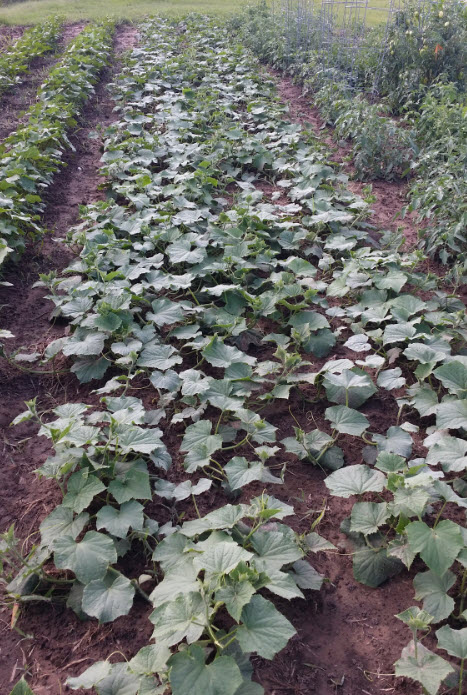
Cucumber Plants shown  in the garden  are "Market More", May 29, 2014

“Market More” Cucumbers, May 29, 2014

What a year this has been for cucumbers! The mild temperatures and frequent rains just encourage them to grow! This year, the first 2 sets of planted cucumbers were damaged by late frosts in May — our 3rd planting produced an abundance of these “Market More” variety plants. Continue reading

Christine's avatar

Callie

Toy Manchester Dog named Callie, August 11, 2014

Callie, August 11, 2014

It has been a difficult week. Anyone who has pets deeply embedded into family life knows that when that pet dies, it’s just like losing a family member. Callie came to us in 2001 as an energetic, full of life 4 year old rescue. What a personality she had! She was one of two “first dogs” for our son, so there are many many family memories tied her existence.

This picture was taken August 11. Callie died on August 12.

Callie became diabetic after receiving an excessive amount of steroids for a condition she was fighting off as a 5-year old. So, the daily routine of insulin morning and night became part of our routine—for 13 years. Once regulated with insulin, she was back to her vibrant, vigorous self! She took it all in stride … including the twice a day injections — followed by food of course!

She was a great companion in the garden, too. She kept an eye out for snakes and rodents, and promptly shooed them away.  She didn’t dig in the beds or damage plants–ever—she just enjoyed being outside and rolling in the sweet green grass, or the drought-singed hay grass—whatever was available.

She fought hard and never gave up, not even when the terrible seizures brought her to instances of near death… at least 5 times. We were out of town when the seizures started. She waited for us to return and greeted us with her usual full-body tail wag (at least as best she could move by then). Tumors in the brain, we didn’t know, then she went in a matter of days.

Dear little Callie girl, We will miss you and here’s just part of what we learned  from you:

1. Keep the bad things in short-term memory and the good things in long-term memory.

2. Get up every morning and stretch!

3. Follow the rules you impose on others.

4. Take care of those you love; watch out for them, help keep them safe from the dangers of this world.

5. Embrace every morning and every opportunity for joy.

6. Explore your world, you just never know what you will find.

7. Help keep the house clean! (She found bits and pieces of paper that she would pick up and bring to us. After receiving treats for such actions, she continued until her eye sight began to fade early this year.)

8. Eat healthy snacks (she loved carrots for treats — and they were “diabetes friendly”).

9. Take long walks in nature, it calms the restless mind.

10. Chronic illness is not enough to stop joy and happy times; make the most of EVERY day.

11. Always Always Always, openly and freely show how much your loved ones mean to you … every day … every time they return—even if it was just a trip to the grocery store or a short errand.

Thank-you, little Callie girl, for all the fun and happiness you brought to our lives. We will miss your bright spirit!


Christine's avatar

Ways to Store Figs

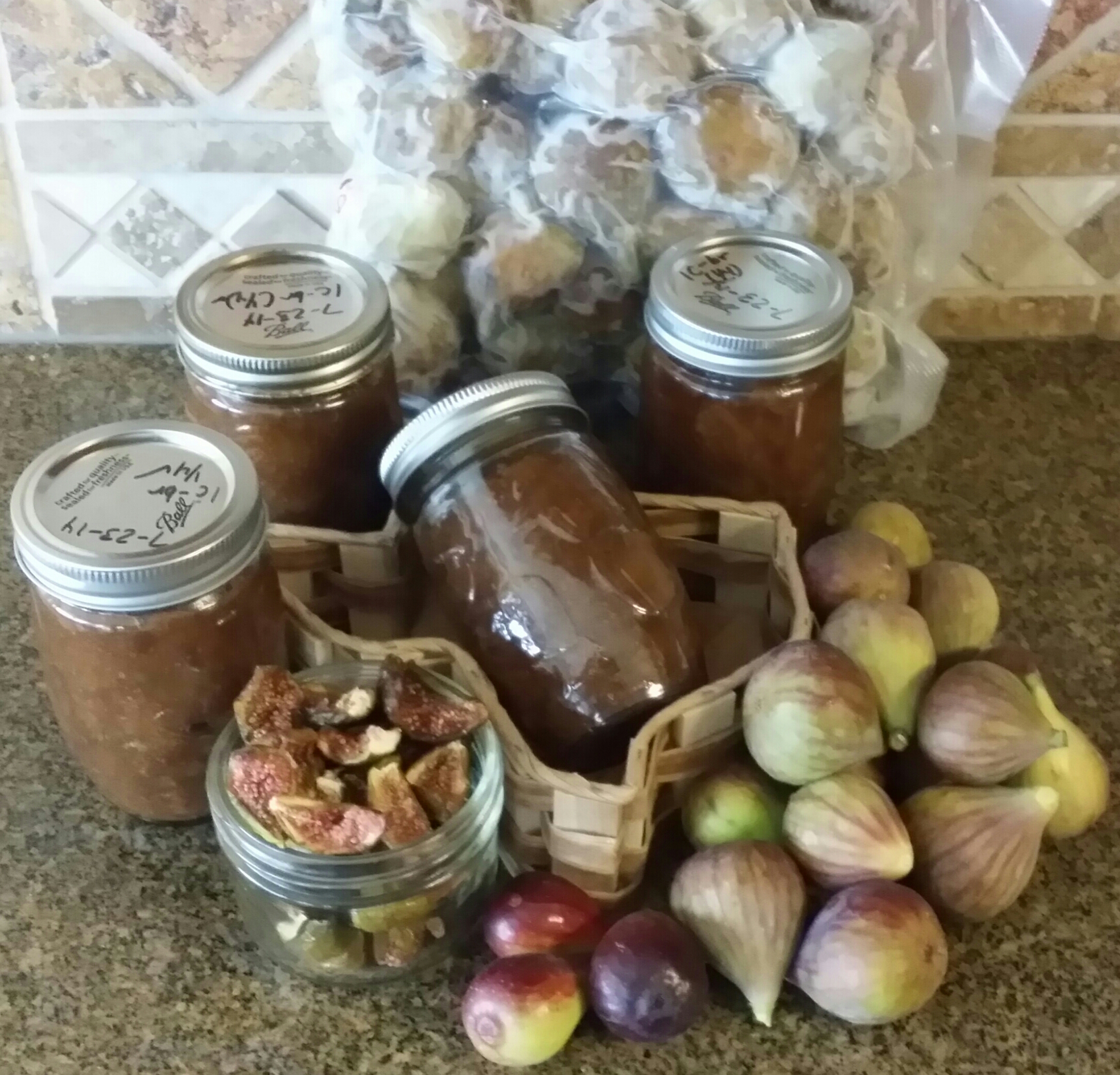
Shown are dried figs, frozen packaged figs, canned fig preserves, and fresh figs

Figs and Storage, July 2014

Fresh figs are quite a treat, but they are very perishable and strategies for storage is essential—especially when produced in abundance in a home garden, !

Figs can be stored frozen, or dried (in the small opened jar), or as canned preserves (see photo).

We have two fig trees an LSU Purple (the darker purple at the bottom, center of the photo) fig and Alma (to the right side, an Aggie product from  Texas A&M horticulture).

This year, there is an abundance of figs, but the cool, damp weather has caused the figs to ripen slower than usual. Continue reading

Christine's avatar

The “Red” Daylilies

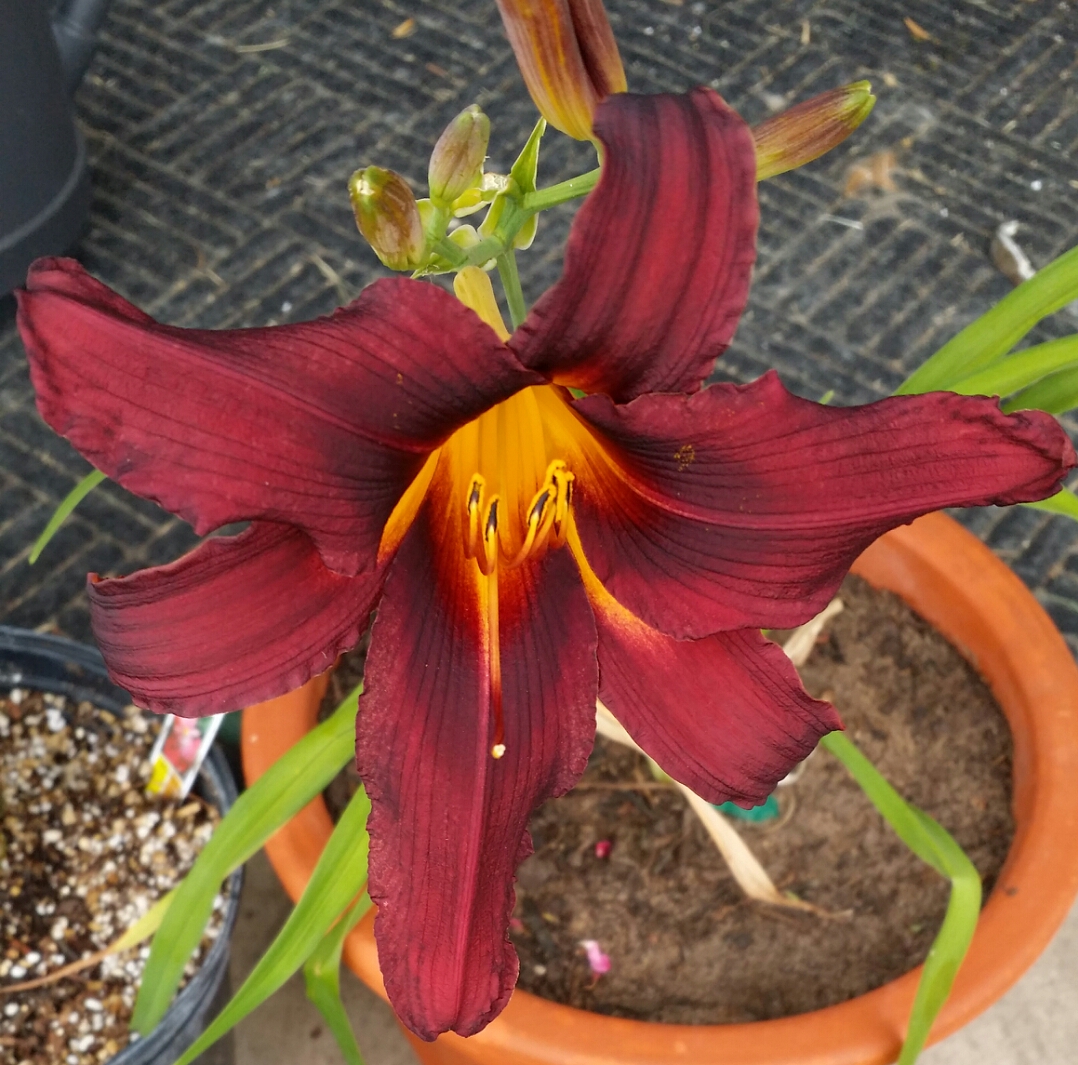
Picture of maroon-colored daylily, 'Theron'

‘Theron’, May 2014

There are two “red” daylilies in my perennial gardens; one is ‘Prelude to Love’ and the other is ‘Theron’. I describe each of them as maroon–probably due to my Aggie lens! (We are both Texas A&M University former students).

Theron was the first “red” daylily—bred by Stout and released in 1934 (Dormant, blooms mid-May throught mid-June, no repeat) This was a pass along plant for my mother-in-law, and I acquired it from her about 8 years ago. I found it in a garden bed near the house, shaded from overgrown oak trees planted over 20 years earlier (but originally in full sun). Once carefully dug, I realized that there really wasn’t much time left because the tubers were tiny and there were only 3 of them. With care, I managed to bring it back to blooming and spreading.

Purchase in 1995, ‘Prelude to Love’ was one of the first daylilies I bought (that maroon lens again!).

Maroon to red colored daylily pictured.

‘Prelude to Love’, June 2014

This is a dormant, mid-June through July repeat bloomer.

Until this year, I thought that both of these were gone. They were discovered in unruly clumps of daylily tubers and roots—continued growing, but ceased blooming.

This year, they both have new locations in the improved raised bed. I expect to see a lot more of both of them from now on!


Christine's avatar

Red Spotted Weevil on Sunflowers

This picture illustrates weevil insect damage on sunflowers; holes with brown, rotting edges, and top of the plant cut off.

Damaged Sunflower, May 2014

When I found holes in the stem and about a food missing at the top of this sunflower (pictured above), I didn’t expect to find a tiny weevil responsible for the damage!

Picture of a Red Spotted Weevil on Sunflower, May 2014; the red body, black spots, and distinct elongated "snout" are shown.

Red Spotted Weevil on Sunflower, May 2014

Weevils cause plant damage by using mouth parts and drilling holes in the plant, then feeding on the plant sap. These weevils have “snout” (see picture above) structures similar to the boll weevil—a major economic pest on cotton.

Christine's avatar

Tomato Variety 444 by TAMU

444 Tomato Variety, picture of green fruit

444 Tomato Variety

The 444 tomato variety (also identified as BHN 444)  was bred by horticulturalists at Texas A&M University in College Station, Texas.

This variety has demonstrated strong resistance to Tomato-Spotted Wilt Virus and grows well in the South Texas summer heat.

It is determinate (bush varieties that produce a flush of  tomato fruit and then stops growing) and has been used by commercial producers.

The plants are relatively small (up to 2 feet in any direction) for the volume of tomato fruit. These plants were exposed to 3 light frosts in early May, so the actual size should be larger—but the fruit is still setting, despite the stunted growth! So far, it is meeting all expectations in our garden!

To be continued …


Resources:

Fight Heat and Disease with ‘TOMATO 444’  accessed online, May 28, 2014 at —-   http://aggie-horticulture.tamu.edu/cemap/tomato444/tomato444.html last accessed May 28, 2014.


Christine's avatar

Spring Prep ….

Hand Tools for Gardening

Hand Tools for Gardening

Now’s the time to pick up a set of hand tools if you need them. Gardeners will be out in mass as soon as the temperatures become milder and the notion of an approaching Spring becomes more reality than dream. It’s also time to check if cutting and shearing tools need sharpening.

Here’s a few tasks on my Valentine’s Day “to do” list (USDA zones 8-10):

  • prune roses (purchase, or get cutting tools sharpened, if needed)
  • plant potatoes
  • find and purchase mulch
  • find desired bulbs for Spring and Summer (they sell quickly!)
  • have soil tested
  • get garden plans together (what will grow, where)

… Dreaming of Spring Gardening …..

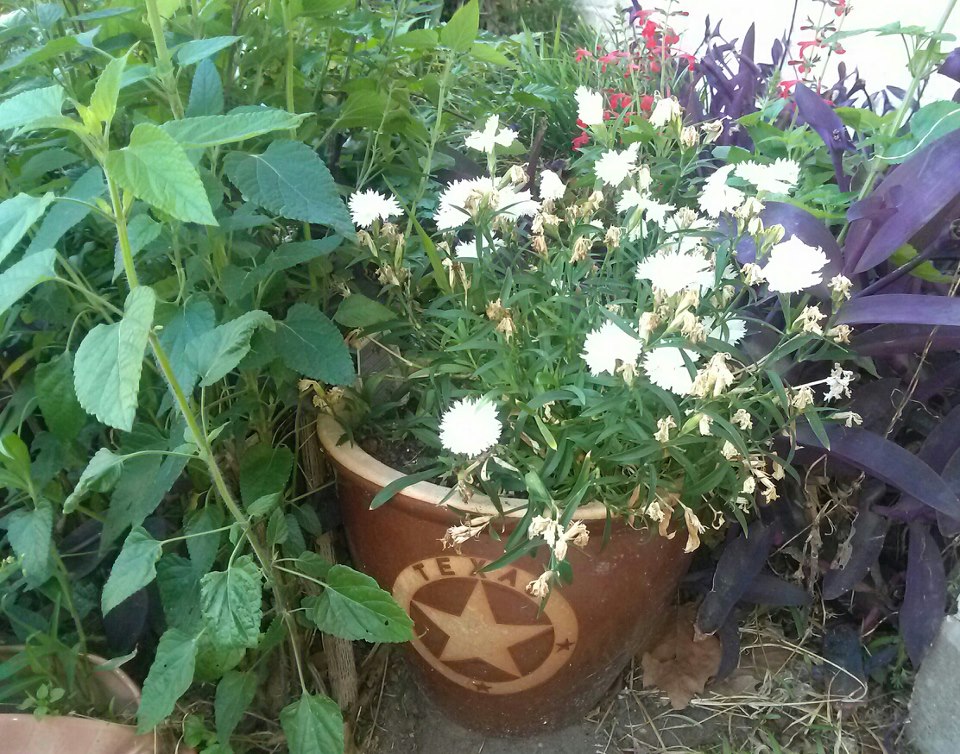
Texas planter picture