

White Flag Iris
The white flag iris blooms each Spring (provided that a late freeze doesn’t damage the buds and blooms) and Continue reading

White Flag Iris
The white flag iris blooms each Spring (provided that a late freeze doesn’t damage the buds and blooms) and Continue reading



Four kinds of blooms I’ve seen this week are; Continue reading

Red Bud Tree against the Spring Sky
The Southern Redbud tree in my garden has dependably attempted to produce the bright pink blooms each year about early March. I say “attempted” because Continue reading

Freshly Pulled Carrots! March 7, 2015
The carrots are ready for harvesting.
We usually pull a few at a time Continue reading

Tiny Insects on Daylilies
Tiny insects are showing up on my plants — especially the potted daylilies that have been placed on the porch. Continue reading

Chrysler Imperial, Climbing; Oct. 2014
In zone 8b, we are preparing for Spring and I’m always looking for a reason to be out in the gardens. So, with Valentine’s day here and gone, don’t forget to prune and care for the roses! Here are a few steps;
1. remove all dead stems
2. rake leaf debris and remove — to reduce the amount of any potential plant pathogens that will be splashed up onto the rose leaves during Spring rains.
3. Add compost
4. Top off with mulch
5. Wait for upcoming new growth and blooms!
Despite the gloomy prediction by phil the groundhog, I’m planning for spring to be here soon! One way to begin to prepare is to locate a good source of mulch! Here are a few tips for selecting the best mulch for your purposes:

Organic Mulch in Bulk
The greenest way (most earth-friendly) way to buy organic mulch (shredded wood or bark chips) is in bulk — without the plastic bags that are often disposed in the landfill. Buying in bulk is also much less expensive than purchasing the bags. Some individuals dislike the fact that organic mulch breaks down over time, but over time, it adds valuable organic material to loosen the soil and provides pockets for oxygen to be available for roots — critical for good root development. We purchase at least one pick-up load pre-spring and again pre-Fall — both good times to spruce up the appearance of the garden, as well as provide “in progress” compost.
Load mulch into the wheelbarrow and deliver to garden beds as needed (great arm-strengthening activity that also burns the calories — and the process is awesome for relaxing the mind).
Adding about 2 inches of mulch before weeds begin to sprout is a great way to limit what will sprout — making the spring weeding just a bit less taxing!
Whatever is not used can be unloaded into a pile (drive the pickup to the location) and then loaded into the wheelbarrow later, as gardening time becomes available. My schedule leaves me unable to garden from Sunday evening through Thursday afternoon, so I work just a bit each day and the results add up! It may take 2 or 3 weeks to completely distribute the bulk mulch, so get started in late December to Early January (Zone 8b)—that’s when I begin!
Happy Mulching!
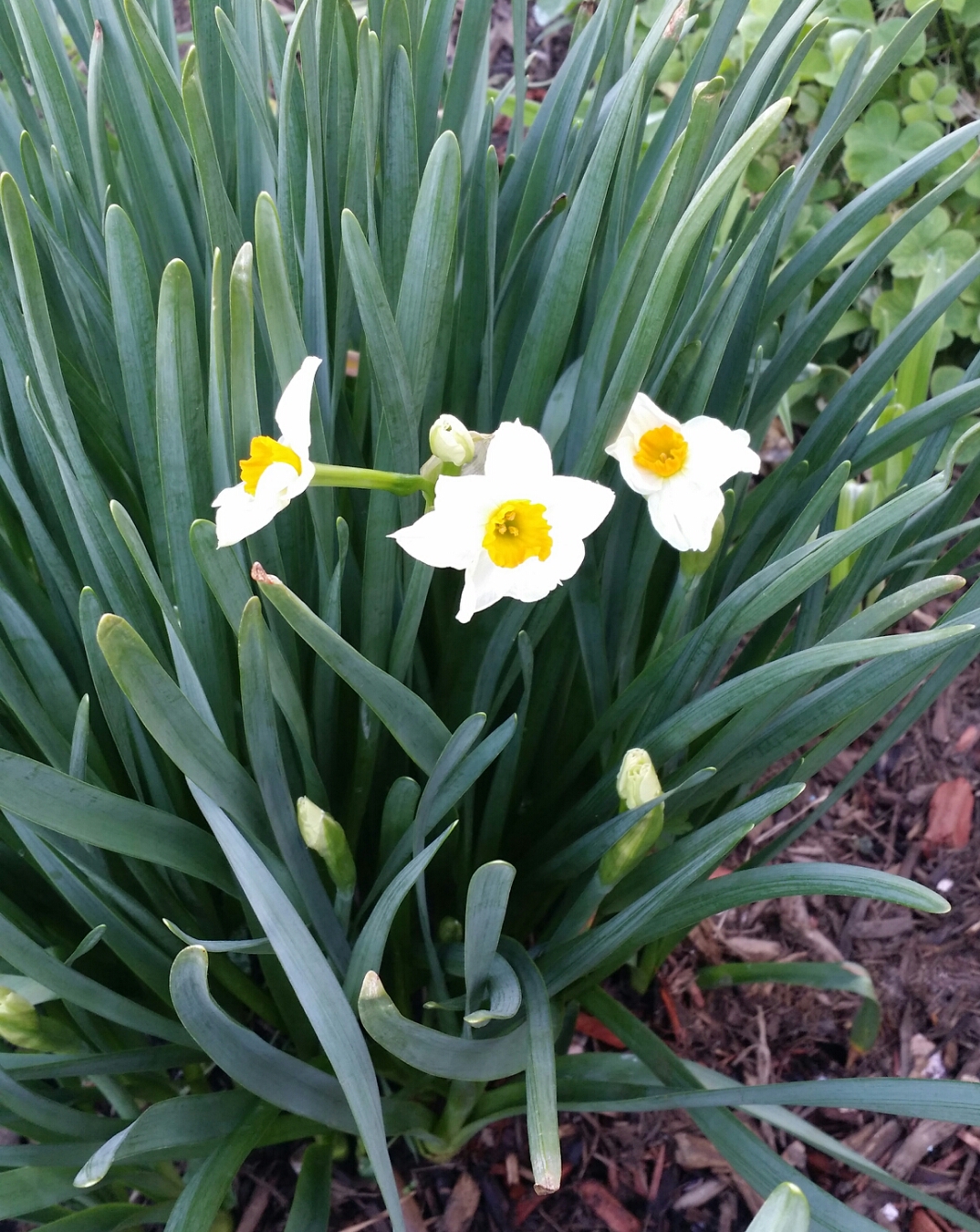
Narcissus, first day of Spring, 2014
Last July, I dug several clumps of daffodil bulbs — narcissus x golden Dawn (pictured left) to save for pass along plants as well as to re-plant in a few new areas. This year, I decided a few need to accent a corner rose bed. Late December to Early January is a great time to plants these bulbs.
While there are a number of varieties of Daffodils (or Narcissus), few tolerate the heat experienced in zone 8b Texas. I’ve had great luck with narcissus x golden Dawn growing, blooming and proliferating each year for at least the past 6 years. Other Narcissus varieties that grow in this area are; Narcissus jonquilla, Narcissus ‘Grand Primo’, and Narcissus x odorus. Continue reading

Trimmed Branches of Live Oak, Jan 2014
Composting plant materials is one of the best sources for Spring garden nutrition and soil amendment. After trimming dead and unruly branches from trees in winter, use that material for compost to revive Spring gardens. The Photo (left) shows the cut branches of live oak, ready for the shredding process.
This post briefly describes composting and how to use the trimmed tree and shrub material for a Spring garden that will reward the efforts! Before trimming trees and/or shrubs, always consult a tree expert for advice—and possibly for the trimming service. (You’ll do the trees a favor and potentially save yourself a bit of grief.) Continue reading

Persimmon Fruit, November 2014
Japanese Persimmons have been grown in Zone 8b since the late 1880s. This tree is extremely disease and insect-resistant and produces bright orange fruit in late Fall. The fully ripened fruit is quite sweet and nutritionally higher in vitamin C than most citrus. Continue reading


 The Art & Science of Gardening